James Janusz 2000 thru 2026 All Rights Reserved |
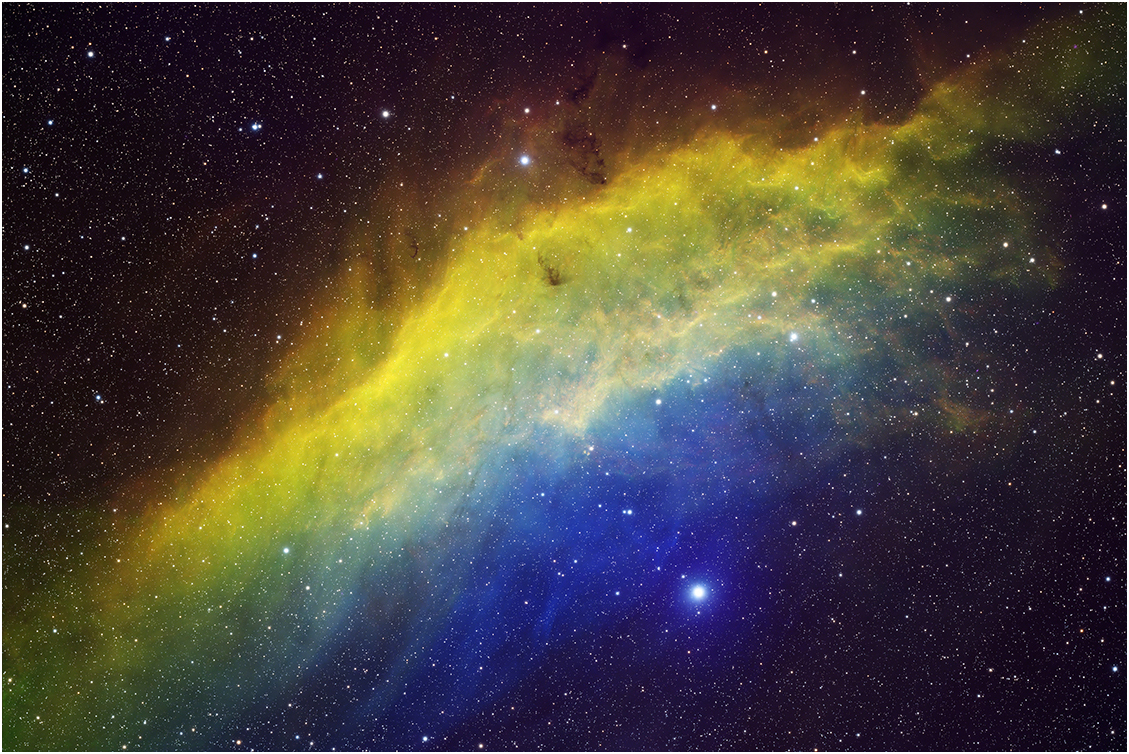
| Telescope: Astro-Physics 092 Stowaway | Description:The California Nebula (Also known NGC 1499 or Sh2-220) is an emission nebula located in the constellation Perseus. Its name comes from its resemblance to the outline of the State of California in long exposure photographs. By coincidence, the California Nebula transits in the zenith in central California as the latitude matches the declination of the object. Infrared image showing Xi Persei's interaction with the nebula including a (red) shock wave in the gas and dust NGC 1499 is almost 2.5° long on the sky and, because of its very low surface brightness, it is extremely difficult to observe visually. It can be observed with an Ha filter (isolates the Ha line at 656 nm) or Hß filter (isolates the Hß line at 486 nm) in a rich-field telescope under dark skies. It lies at a distance of about 1,000 light years from Earth. Its fluorescence is due to excitation of the Hß line in the nebula by the nearby prodigiously energetic O7 star, Xi Persei (also known as Menkib) (Wiki). |
|---|---|
| Mount: Astro-Physics AP1600 GTO | Constellation: Perseus. |
| Camera: ZWO ASI 6200 MM Pro Monochrome Camera. | Remotely Imaged With Voyager. |
| Guiding: ZWO ASI174 guide Camera and 60mm Guide Scope | Type: Emission Nebula. |
| Exposure Data: 15 x 20 minute Ha, SII, and OIII sub exposures with Chroma NB filters. Short RGB subs for stars. | Position: R.A. 04h 03m 18s Dec +36° 25' 18" |
| Processed using Voyager data aquisition, PixInsight and PhotoShop image processing | Date: November 2025 |
| Data Acquisiton, Reduction and Processing by Jim Janusz | Imaging Location: Maor Observatory at Whitetail Hollow |
-END |