James Janusz 2000 thru 2026 All Rights Reserved |
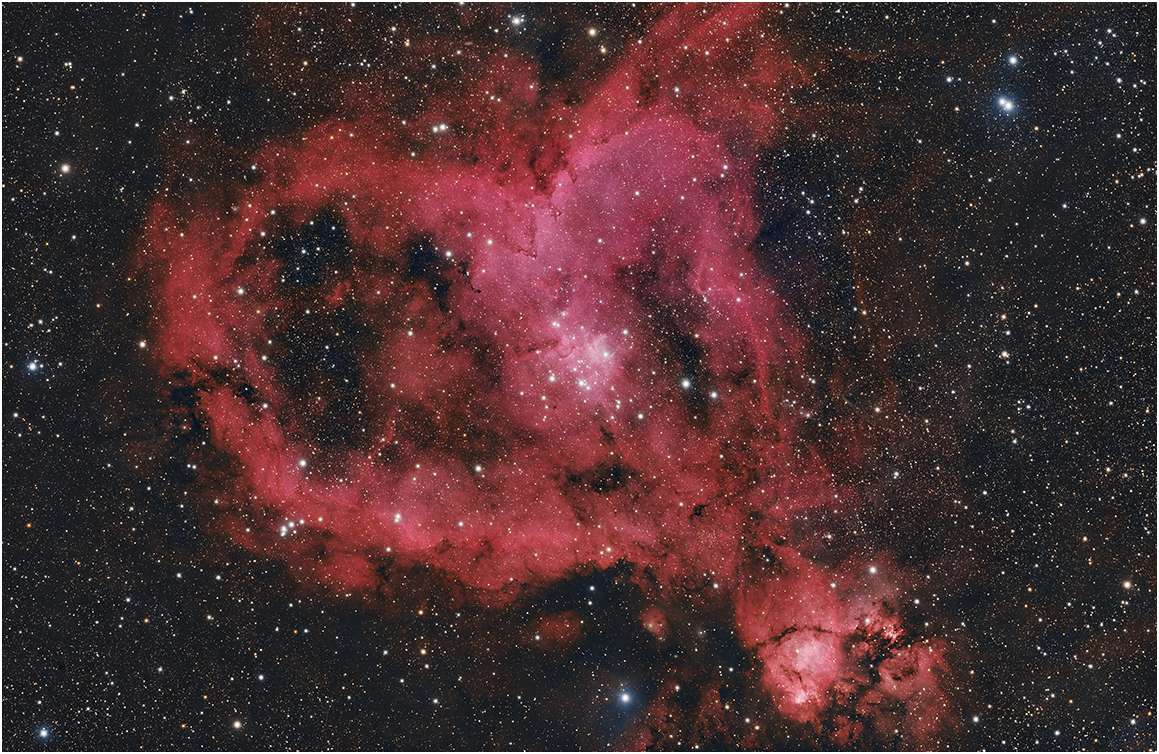
| Telescope: Astro-Physics 092 Stowaway | Description:The Heart Nebula (IC1805) (also known as the Running Dog Nebula, Sharpless 2-190) is an emission nebula, 7,500 light-years (2,300 pc) away from Earth and located in the Perseus Arm of the Galaxy in the constellation Cassiopeia. It was discovered by William Herschel on 3 November 1787. It displays glowing ionized hydrogen gas and darker dust lanes. The brightest part of the nebula (a knot at its western edge) is separately classified as NGC 896, because it was the first part of the nebula to be discovered. The nebula's intense red output and its morphology are driven by the radiation emanating from a small group of hot stars near the nebula's center. This open cluster of stars, known as Collinder 26, Melotte 15, or IC 1805, contains a few bright stars nearly 50 times the mass of the Sun, and many more dim stars that are only a fraction of the Solar mass. The Heart Nebula is also made up of ionized oxygen and sulfur gases, which are responsible for the rich blue and orange colors seen in narrowband images. The nebula also spans almost 2 degrees in the sky, covering an area four times that of the diameter of the full moon. (Wiki). |
|---|---|
| Mount: Astro-Physics AP1600 GTO | Constellation: Cassiopeia. |
| Camera: ZWO ASI 6200 MM Pro Monochrome Camera. | Remotely Imaged With Voyager. |
| Guiding: ZWO ASI174 guide Camera and 60mm Guide Scope | Type: Star cluster and Nebula. |
| Exposure Data: 25 x 5 minute (10 minute Ha) sub exposures with Chroma Ha-RGB filters. | Position: R.A. 02h 33m 22s Dec +61° 26' 36" |
| Processed using Voyager data aquisition, PixInsight and PhotoShop image processing | Date: October 2025 |
| Data Acquisiton, Reduction and Processing by Jim Janusz | Imaging Location: Maor Observatory at Whitetail Hollow |
-END |