James Janusz 2000 thru 2026 All Rights Reserved |
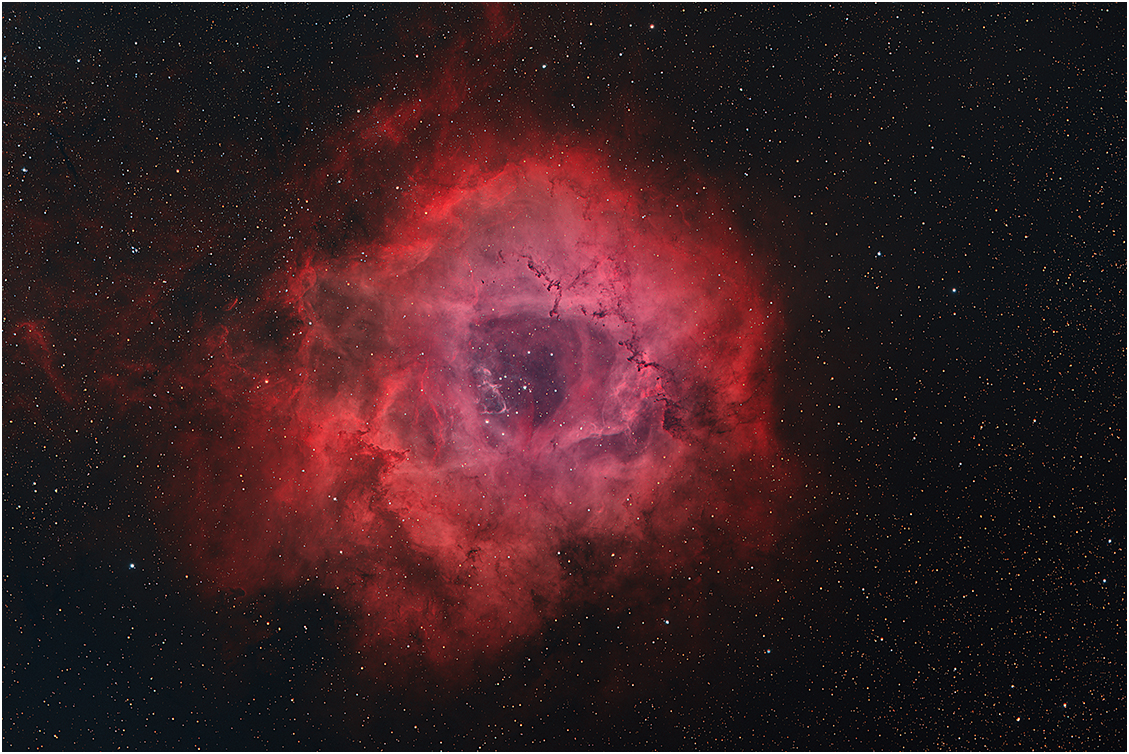
| Telescope: Astro-Physics 092 Stowaway | Description:The Rosette Nebula (also known as Caldwell 49), SH2-275 is an H II region located near one end of a giant molecular cloud in the Monoceros region of the Milky Way Galaxy. The open cluster NGC 2244 (Caldwell 50) is closely associated with nebulosity; the stars of the cluster having been formed from the nebula's matter. The complex has the following New General Catalogue (NGC) designations: NGC 2237 – Part of the nebulous region (Also used to denote whole nebula) NGC 2238 – Part of the nebulous region, NGC 2239 – Part of the nebulous region (Discovered by John Herschel), NGC 2244 – The open cluster within the nebula[6] (Discovered by John Flamsteed in 1690), NGC 2246 – Part of the nebulous region. The cluster and nebula are 5,000 light-years from Earth and measure roughly 130 light years in diameter. The radiation from the young stars excites the atoms in the Nebula, causing them to emit radiation themselves producing the emission nebula we see. The mass of the Nebula is estimated to be around 10,000 solar masses. (Wiki). |
|---|---|
| Mount: Astro-Physics AP1600 GTO | Constellation: Monoceros. |
| Camera: ZWO ASI 6200 MM Pro Monochrome Camera. | Remotely Imaged With Voyager. |
| Guiding: ZWO ASI174 guide Camera and 60mm Guide Scope | Type: HII Nebula and Cluster. |
| Exposure Data: 20 x 10 minute Ha and SII, (HOO color pallet) sub exposures with Chroma NB filters. Short RGB subs for stars. | Position: R.A. 06h 33m 45s Dec +04° 59' 54" |
| Processed using Voyager data aquisition, PixInsight and PhotoShop image processing | Date: February and March 2026 |
| Data Acquisiton, Reduction and Processing by Jim Janusz | Imaging Location: Maor Observatory at Whitetail Hollow |
-END |