James Janusz 2000 thru 2026 All Rights Reserved |
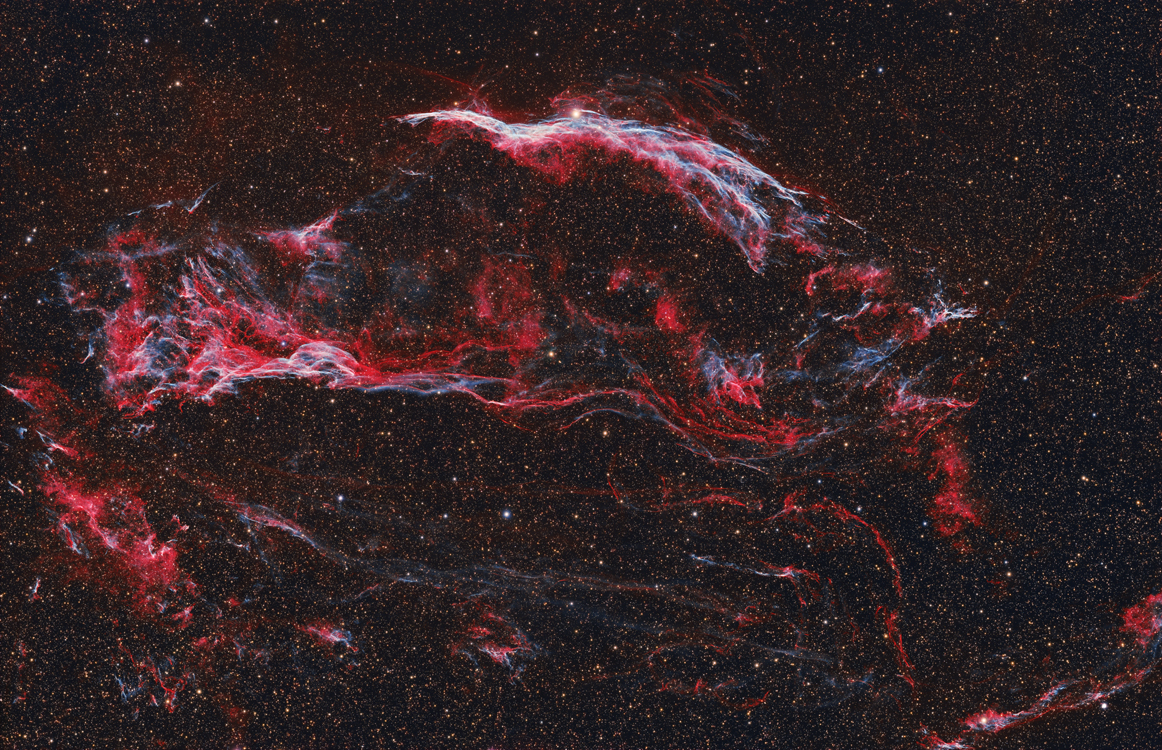
| Telescope: Astro-Physics 092 Stowaway | Description:Why It Looks Like That: Shockwaves from the supernova blast through interstellar gas, exciting oxygen (blue-green), hydrogen (red), and sulfur (pink) ions. Filaments trace magnetic fields and density variations. How to Observe Best time: Summer (Northern Hemisphere) in Cygnus Equipment: Naked eye: Not visible Binoculars: Faint glow near 52 Cygni (in Western Veil) Telescope + OIII filter: Reveals intricate details Location: Dark skies (Bortle 4 or better) Fun Facts: The progenitor star was a star 20 times more massive than the Sun and likely exploded ~10,000 years ago, but light took 2,100 years to reach us. Expands at ~600,000 km/h; total span ~120 light-years. Hubble, JWST, and amateur astrophotographers have produced jaw-dropping images. (Grok). |
|---|---|
| Mount: Astro-Physics AP1600 GTO | Constellation: Cygnus |
| Camera: ZWO ASI 6200 MM Pro Monochrome Camera. | Remotely Imaged With Voyager. |
| Guiding: ZWO ASI174 guide Camera and 60mm Guide Scope | Type: Super Nova Remnant (SNR). |
| Exposure Data: 33 x 15 minute sub exposures with Chroma Narrow Band filters. | Position: R.A. 20h 45m 38.0s Dec +30° 42' 30" |
| Processed using Voyager data aquisition, PixInsight and PhotoShop image processing | Date: October 2025 |
| Data Acquisiton, Reduction and Processing by Jim Janusz | Imaging Location: Maor Observatory at Whitetail Hollow |
-END |